
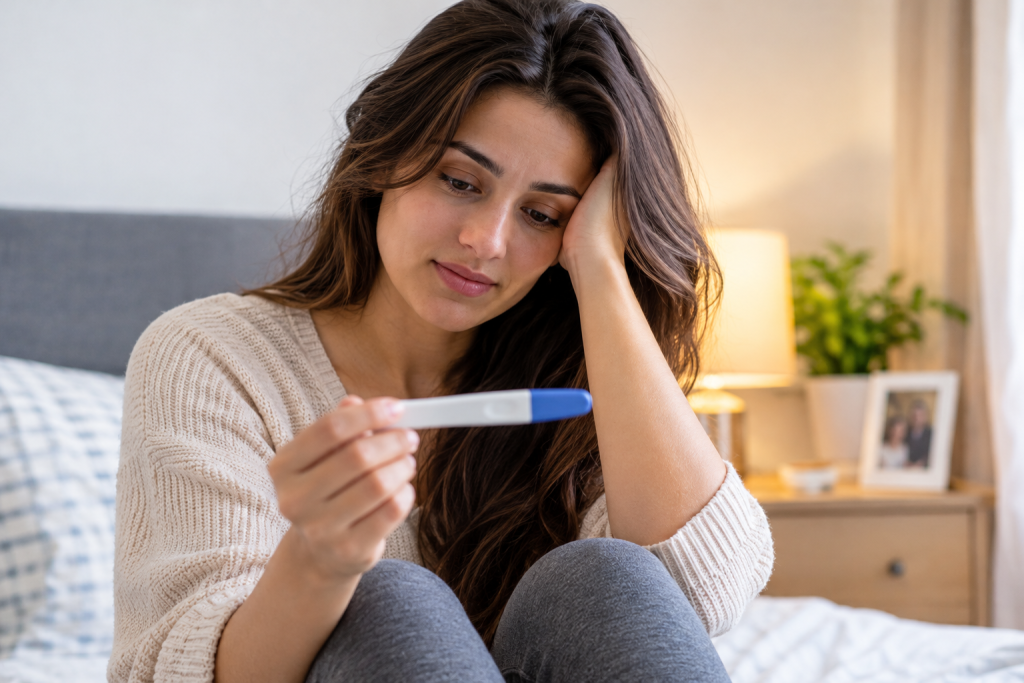
Pregnancy after miscarriage is on your mind for a reason. You want a date, a number, some kind of promise.
We can’t promise anything. We can give you the facts doctors actually use, and they’re better than the fear suggests: about 85 in 100 women who miscarry once go on to have a healthy baby.
Below you’ll find the timing (earlier than most people think) and what a pregnancy test can and can’t tell you right now. There are also 7 habits worth starting before you try. Read what fits. Skip what doesn’t. Your own doctor knows your history, so take your questions to them.
What happens to your body after a miscarriage
Bleeding usually lasts 1 to 2 weeks. You’ll have cramps, and some days you’ll feel wrung out for no clear reason because your hormones are dropping fast.
How the loss happened changes things a little. One that passes on its own, one managed with tablets and one treated with a D&C each recover slightly differently, so ask your doctor what to expect for yours.
Call your doctor if the bleeding is heavy, you get a fever or the pain keeps building. The full list of warning signs is near the end.
Fertility after pregnancy loss
Here’s something that surprises people. Fertility after pregnancy loss often snaps back within 2 weeks. You can ovulate, and get pregnant, before you’ve had a single period.
So how soon can you get pregnant after miscarriage? Sooner than your mood might suggest. If you’re not ready, start contraception that same week. Our family planning team can sort out a method with you.
Here’s a rough timeline. Yours will wander a bit.
Milestone | Typical timing | What to know |
Bleeding settles | 1 to 2 weeks | Light spotting can last longer |
Ovulation returns | As early as 2 weeks | You can conceive before a period |
First period | 4 to 6 weeks | May be heavier or lighter than usual |
hCG clears | 4 to 6 weeks, sometimes longer | Pregnancy tests may still read positive |
Cycles settle | 1 to 3 cycles | Odd timing is common at first |
A cycle or two of strange timing is normal. Don’t panic over it.
Your first period after miscarriage
The first period usually turns up 4 to 6 weeks after the loss. Expect surprises: heavier flow, stronger cramps, or a light one that barely counts.
No period after 8 weeks? Call your doctor (unless you’re pregnant, obviously). Same goes for soaking a pad every hour.
Getting pregnant after miscarriage tends to be easier than people fear. But if your cycles stay messy for a few months, a few fertility tests can show what’s going on.
When to try again after miscarriage
You may have heard you should wait 3 to 6 months. Doctors have mostly dropped that rule.
What doctors say now
The American College of Obstetricians and Gynecologists says there’s no medical reason to wait after an early loss. Their early pregnancy loss FAQ is short and readable.
An NIH study went a step further. Women who tried again within 3 months were more likely to have a live birth than those who waited longer. The researchers found no physical reason to hold off.
Plenty of doctors still ask for one normal period first. It’s mostly about dating, since counting weeks is easier when you know when your last period started. You can skip it if you like.
A simple way to decide
Two questions. Has the bleeding stopped? Do you feel ready to hope again?
Two yeses mean go ahead. Any no, wait a bit longer. Your odds won’t suffer either way.
A few situations need your doctor’s okay first:
- A loss after 12 weeks
- An ectopic or molar pregnancy (a molar pregnancy usually means several months of hCG checks before trying again)
- An infection or heavy bleeding
- Surgery that took longer to heal
Emotional recovery after miscarriage
Emotional recovery after miscarriage runs on its own clock. One woman is ready in a month. Another needs a year. Some feel relief (that’s normal) or very little at all.
Grief likes to ambush people. A due date rolls around, or a friend announces her pregnancy, and you’re flattened. Partners hurt too, often in silence.
Trying to conceive after miscarriage can feel like betting on a horse you’re afraid will fall. Most women feel that. It eases as the weeks pass.
If sadness or anxiety is wrecking your days for more than 2 weeks, tell your doctor. Counseling works well after pregnancy loss.
Pregnancy after miscarriage success rate
The number everyone wants first: about 85 in 100 women who’ve had one miscarriage go on to a healthy pregnancy next time.
Losses in a row | Chance the next pregnancy goes well (approximate) |
1 | About 85 in 100 |
2 | About 75 in 100 |
3 or more, cause unknown | About 65 in 100 |
Those are averages, so hold them loosely. Age matters a lot. After 40, more than 1 in 3 pregnancies ends in loss. Your health and the cause of your own loss shift things too.
Repeated loss is rare. Only about 1 in 100 women has 3 or more in a row.
Why most miscarriages happen
Usually it’s a chromosome error in the embryo, a random slip when cells divide. Nothing you ate or lifted caused it.
Exercise doesn’t cause miscarriage. Neither does sex, a rough week at work or birth control you took years ago.
You didn’t do this.
Signs of pregnancy after miscarriage and when to test
Pregnancy test after miscarriage
Testing too soon will mess with your head. After a loss, hCG (the pregnancy hormone) lingers for 4 to 6 weeks, sometimes longer. A pregnancy test after miscarriage can stay positive that whole time.
Best plan: wait for your first period, then test. A positive after that is far more likely to be new.
Already tested and got a line? Test again in 2 days. Fainter means leftover hormone. Darker means probably a new pregnancy. Your doctor can confirm with a blood test that checks whether hCG is rising.
Early signs of pregnancy after miscarriage
Same list as ever: a late period, sore breasts, tiredness, queasiness, constant bathroom trips. Signs of pregnancy after miscarriage aren’t special.
They aren’t reliable either. Plenty of women feel awful in a healthy pregnancy, and plenty feel nothing. One rough morning tells you little (and neither does one good one).
Pregnancy after early miscarriage
An early miscarriage means a loss before 12 weeks. Pregnancy after early miscarriage usually goes fine, because one early loss raises your risk only a little.
Pregnancy after miscarriage without complications is the normal outcome. Most women need regular prenatal visits and some extra reassurance.
7 tips for a healthy pregnancy after miscarriage
Preparing for pregnancy after miscarriage works best as a few small habits you’ll actually keep. Here are 7.
1. Make room for your feelings
Say it out loud to someone, even the ugly parts. A friend who’s been there is gold. A loss support group is another good option, because nobody there needs it explained.
If the sadness hangs on, see a counselor. You don’t need to hit rock bottom first.
2. Book a check-up before you try
A preconception visit feels like any other appointment. The doctor reviews what happened, your cycles, your medicines and your vaccines. After a single miscarriage, heavy testing is rare.
Our general gynecology service handles these visits. Had heavy bleeding or a D&C? A pelvic ultrasound can check the uterus.
One more question for the doctor: what’s my blood type? Rh negative women may need an anti-D injection after a loss.
3. Start folic acid now
Take 400 micrograms a day, starting a month or more before you try. Folic acid lowers the risk of neural tube defects. Most prenatal vitamins already contain it.
Some women need a bigger dose, for example with diabetes or epilepsy medicine. Ask your doctor.
4. Sort out the daily basics
Nothing dramatic here. Just the boring stuff done consistently.
What to keep doing
Meals at regular times. Vegetables at most of them. A walk or a swim most days. Seven hours of sleep if you can manage it (night shifts make that hard, so do what you can).
What to cut back
Cigarettes, vaping and alcohol all raise miscarriage risk, so those go first. Then caffeine: stay under 200 mg a day, roughly one 12 oz coffee. Two large lattes from a café can blow past that.
5. Get long-term conditions under control
Thyroid disease, diabetes, PCOS and high blood pressure all change how a pregnancy goes. Well controlled, they usually cause little trouble. Poorly controlled, they can.
Make a list of every medicine and supplement you take and show it to your doctor. Stopping a prescription on your own is a bad idea.
6. Ask about early pregnancy monitoring
Some women get an ultrasound at 6 to 8 weeks. Some get two hCG blood tests a couple of days apart. Early pregnancy monitoring after miscarriage can settle your nerves and spot an ectopic pregnancy early, though it can’t stop a miscarriage.
Is it right for you? Ask. Our antenatal care team can plan a schedule around your history.
7. Start prenatal care early
Call as soon as the test turns positive. Waiting until 10 or 12 weeks feels brave but helps nobody. Tell the team about your loss on day one.
For many women a healthy pregnancy after miscarriage looks like any other pregnancy with a few extra check-ins. If your history is more complicated, our high risk pregnancy care adds closer follow-up.
When to call your doctor
Spotting happens in healthy pregnancies but still deserves a phone call. You’ll sleep better.
About 1 to 2 in 100 pregnancies are ectopic, with the embryo growing outside the uterus. Rare, yes. Dangerous, also yes. That’s why this list matters.
Warning signs to know
Go to the emergency room now
- Bleeding that soaks more than 2 pads an hour for 2 hours in a row
- Sudden sharp pain on one side of your belly, or pain in your shoulder
- Fainting or severe dizziness
- Fever with chills, strong pain or foul-smelling discharge
Call your doctor soon
- Bleeding or spotting once you have a positive test
- Cramping that doesn’t ease
- Red bleeding that returns after it had stopped
- No period 8 weeks after the loss
Testing after repeated pregnancy loss
After 2 or more losses in a row, doctors start looking for causes. After one, they usually don’t.
What the tests involve
Expect bloodwork for thyroid function, blood sugar and clotting antibodies. You’ll likely get an ultrasound of the uterus too. Some couples also have chromosome tests, on both partners or on the pregnancy tissue. Our genetic counseling team can explain the results.
Many couples never get a cause. It’s maddening. Still, about 65 in 100 women with unexplained repeated loss go on to a successful pregnancy.
When to see a specialist
Go after 2 losses or any loss past 12 weeks. Go if you’re 35 or older and 6 months of trying has gone nowhere. A specialist can run fertility tests and map out the next steps.
The first trimester after miscarriage
Those first 12 weeks drag. You may catch yourself holding your breath at every bathroom trip. Scan days are the worst.
What helps:
- Ask for an early scan if waiting is eating you alive, and say why
- Keep a running list of questions for each visit
- Tell 1 or 2 people so you’re not carrying it alone
- Stay off symptom forums at 2 a.m.
- Tell your care team you’re anxious. They hear it all the time.
Once a scan shows a heartbeat, the risk of loss falls sharply. Take that win.
Getting care in Dubai
Dr. Zohreh Kazemi is an obstetrician and gynecologist at Trusta Medical Center in Downtown Dubai. Her work covers pregnancy planning, antenatal care and fertility questions. You can read more about Dr. Zohreh Kazemi on the site.
For a first visit, bring:
- The date of your loss and how far along you were
- Any scan or lab reports
- A list of your medicines and supplements
- The first day of your last period
Frequently asked questions
Can I have sex after a miscarriage?
Most doctors say yes once the bleeding stops and you feel up to it. That’s often 1 to 2 weeks. Waiting cuts the small infection risk. If you don’t want a new pregnancy yet, use contraception. Ovulation can return within 2 weeks.
Does a D&C affect my chances of getting pregnant?
Usually not. Rarely, scar tissue forms inside the uterus (Asherman syndrome) and periods get very light or stop. If that happens after your D&C, tell your doctor.
Can supplements prevent another miscarriage?
Folic acid in a prenatal vitamin protects the baby’s spine and brain. Nothing has solid proof for preventing miscarriage itself. CoQ10 and vitamin D get a lot of hype. Check with your doctor before spending money on them.
How long should we try before asking for help?
Under 35, give it 12 months. At 35 or older, 6 months. Go sooner if your cycles haven’t come back or something feels off.
Should my partner get tested?
After a single loss, no. After 2 or more, chromosome testing for both of you can be part of the workup. Your doctor will say what makes sense.
When can I exercise again?
Gentle walking is fine within days if you feel up to it. Build back to your usual routine as bleeding and pain ease. After a D&C or heavy bleeding, ask first.
The short version
Pregnancy after miscarriage is common. Most of it ends well. Try again when your body has healed and your head is in it. For some women that’s weeks away. For others it’s a year. Both are fine.
Before you start, book a check-up and take folic acid. Ask about early monitoring. Book prenatal care the minute you test positive. Look after your mind too.