
You’ve taken a test and seen two lines. Now you want to see it on a screen.So, how soon can pregnancy be detected by ultrasound? A transvaginal scan can usually show a tiny gestational sac at about 4.5 to 5 weeks of pregnancy. A heartbeat tends to appear around 6 weeks.Those weeks are counted in …

You’ve taken a test and seen two lines. Now you want to see it on a screen.
So, how soon can pregnancy be detected by ultrasound? A transvaginal scan can usually show a tiny gestational sac at about 4.5 to 5 weeks of pregnancy. A heartbeat tends to appear around 6 weeks.
Those weeks are counted in a specific way. Let’s start there.
How pregnancy weeks are counted
Doctors count from the first day of your last period. That’s about 2 weeks before you actually conceive.
So at 4 weeks, you’ve only just missed your period. The embryo is still extremely small.
If your cycles are long or irregular, your dates can shift. In that case the scan itself tells your doctor more than the calendar does.
How soon can pregnancy be detected by ultrasound? A week by week timeline
Here’s what a scan can usually show at each stage. Every pregnancy moves at its own pace, so treat these as typical ranges.
Weeks | What a scan may show | What it means |
Before 4.5 | Usually nothing | Too early for most scans |
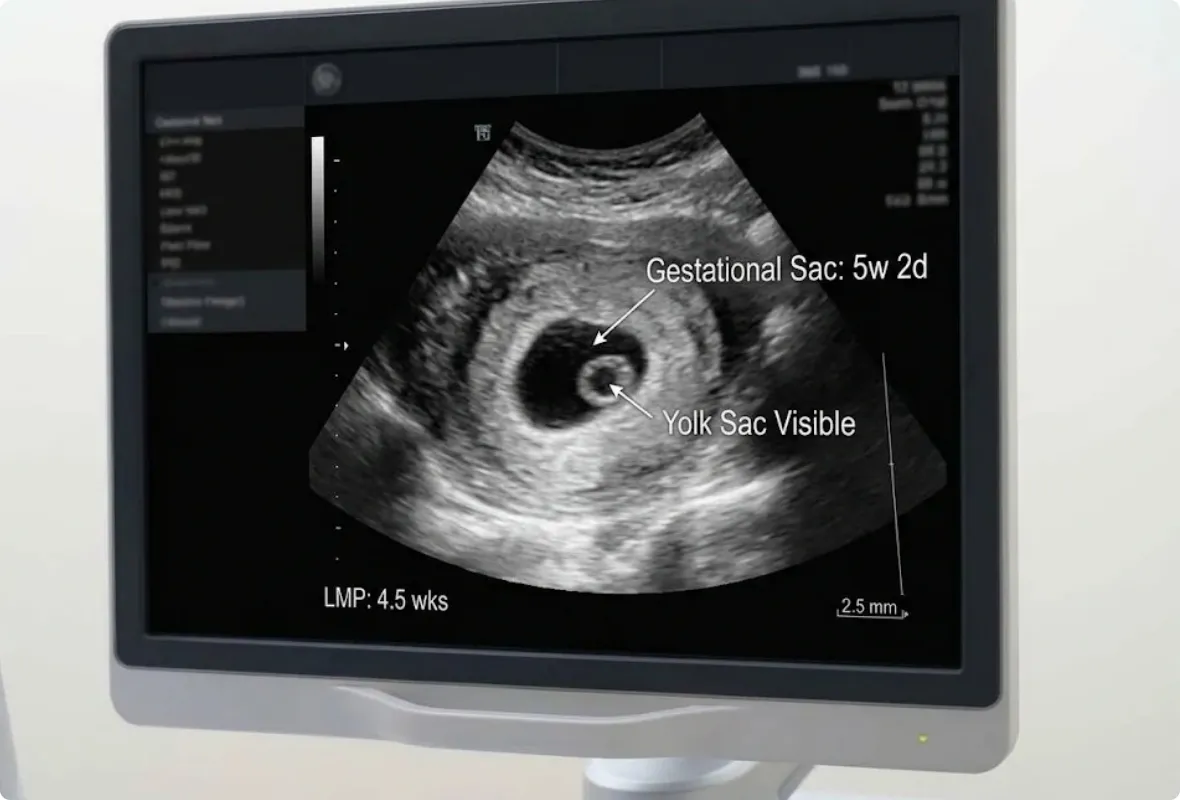
4.5 to 5 | Gestational sac | A small fluid-filled sac in the uterus |
5 to 5.5 | Sac, sometimes a yolk sac | Early sign the pregnancy is in the right place |
5.5 to 6 | Yolk sac | Supplies nutrients before the placenta takes over |
6 to 7 | Fetal pole and heartbeat | The first visible embryo and cardiac activity |
8 and later | Clear embryo | Heartbeat is easier to measure |
At 4.5 to 5 weeks: the gestational sac
The gestational sac on ultrasound is the first thing a scan picks up. It looks like a small dark circle inside the uterine lining.
Seeing it confirms there’s a pregnancy in the uterus. It doesn’t tell you much about how the pregnancy is developing yet.
At 5 to 6 weeks: the yolk sac
Next comes the yolk sac. On an ultrasound it looks like a tiny ring inside the gestational sac.
Doctors like to see it because it’s a good early sign. A yolk sac inside a sac in the uterus is reassuring.
At 6 to 7 weeks: the fetal pole and heartbeat
The fetal pole is the first visible form of the embryo. A flicker of cardiac activity often shows up beside it.
Many people expect a loud sound when they hear “heartbeat.” At this stage the fetal heartbeat on ultrasound is usually a faint flicker on screen.
At 8 weeks and later: a clearer picture
By 8 weeks the embryo is larger and easier to measure. The heartbeat is stronger and your doctor can estimate your due date with more confidence.
Earliest ultrasound to detect pregnancy: transvaginal vs abdominal
The type of scan changes how early you can see things.
Transvaginal ultrasound in early pregnancy
A transvaginal ultrasound uses a slim probe placed inside the vagina. It sits closer to the uterus so the picture is sharper. This is the usual choice before 8 weeks and it answers the question of how early an ultrasound can detect pregnancy.
It can feel like mild pressure. Most people find it quick and tolerable.
Abdominal ultrasound
An abdominal ultrasound uses a probe on your belly. It’s often less clear early on, so a sac or heartbeat may not show until closer to 6 or 7 weeks.
You may need a full bladder for this one. Your clinic will tell you before the visit.
Both types are safe. Ultrasound uses sound waves with no radiation, and it’s a standard part of pregnancy care.
How hCG levels affect what you’ll see
hCG is the pregnancy hormone your body makes after implantation. In early pregnancy it usually doubles every 48 to 72 hours.
Doctors often expect to see a sac on a transvaginal scan once hCG reaches roughly 1,500 to 3,500 mIU/mL. That’s a guide rather than a rule. Some pregnancies show up sooner and some later.
This is why a blood test sometimes goes hand in hand with an early scan. If the scan shows nothing yet, the hCG trend helps your doctor decide what happens next.
Ultrasound vs home pregnancy test
A home test checks for hCG in your urine. Most work from about the day of your missed period.
An ultrasound answers different questions. It shows where the pregnancy is growing and whether it’s developing as expected.
Home test | Ultrasound | |
What it checks | hCG in urine | The uterus and the pregnancy itself |
Earliest use | Around a missed period | About 4.5 to 5 weeks |
Shows location | No | Yes |
Shows heartbeat | No | Yes, from about 6 weeks |
A test can tell you that you’re pregnant. A scan tells you more about the pregnancy.
What affects how early a scan can see your pregnancy
Two people at the same week can get different results. A few things explain why.
Your cycle and ovulation timing
If you ovulated late, you’re further behind than your dates suggest. A scan at “5 weeks” might really be a scan at 4.
Uterus position and body build
A uterus that tilts backward can be harder to see on an abdominal scan. A higher body mass index can also reduce image clarity. A transvaginal scan usually solves both problems.
Fibroids or past surgery
Fibroids or scar tissue can make the picture harder to read. Your doctor may take extra measurements or repeat the scan.
Fertility treatment
After IVF the transfer date gives your doctor exact timing. That often means the first scan can be planned very precisely.
Why your scan might show nothing
Pregnancy not visible on ultrasound feels scary. In many cases there’s a simple reason.
It’s too early
This is the most common reason. If you scan at 4 weeks the sac may simply be too small to see.
Your dates are off
Ovulation sometimes happens later than expected. You might be 4 weeks by the calendar and closer to 3 weeks in reality.
Something else is going on
Sometimes an early scan can’t find a pregnancy in the uterus even though hCG is positive. Doctors call this a pregnancy of unknown location.
It can mean a very early pregnancy. It can also point to an ectopic pregnancy or a miscarriage. Your doctor will usually repeat the scan in 7 to 10 days and track your hCG.
Get urgent care if you have severe one sided pain or heavy bleeding. Dizziness or shoulder pain needs the same attention.
What a viability scan checks
A viability scan confirms that the pregnancy is alive and growing as expected. It usually happens between 6 and 9 weeks.
Your doctor looks for four things:
- The pregnancy is inside the uterus
- The size of the embryo matches your dates
- A heartbeat is present
- The number of embryos
Sometimes one scan isn’t enough to give a final answer. A repeat scan a week later is common and doesn’t mean anything is wrong.
When can ultrasound confirm pregnancy? Best time to book
For most healthy pregnancies, a first scan between 6 and 8 weeks works well. By then there’s usually something clear to see and measure.
Some people shouldn’t wait. Book earlier if you have:
- Pain or bleeding
- A past ectopic pregnancy
- A previous miscarriage
- Pregnancy after fertility treatment
- Irregular cycles and no clear dates
An early visit also starts your antenatal care. Regular checkups, blood tests and scans all build from that first appointment.
If your history puts you at higher risk, ask about high risk pregnancy care from the start. Closer monitoring can catch problems sooner.
What to expect at an early pregnancy scan
Before your visit
Wear something comfortable. You’ll likely change into a gown for a transvaginal scan.
Write down the first day of your last period. Your doctor will ask for it.
What to bring
- Your home test result or hCG report
- A list of medicines you take
- Notes on any pain or bleeding
What to ask
- Is the pregnancy in the right place?
- Does the size match my dates?
- When should I come back for the next scan?
During the scan
The scan takes about 15 to 20 minutes. Your doctor measures the sac and looks for the yolk sac and fetal pole. They’ll also check for a heartbeat if the timing allows.
You’ll get an explanation on the spot. A good doctor shows you the screen and tells you what you’re looking at.
If you want a clear picture of your pelvic organs as well, a pelvic ultrasound can check your uterus and ovaries at the same time.
After the scan
Ask for a clear plan before you leave. You should know when your next visit is and which symptoms mean you shouldn’t wait.
Later scans to plan for
The first scan is just the start. Most pregnancies include two more key scans.
- 11 to 14 weeks: The dating scan confirms your due date and checks early development.
- 18 to 22 weeks: Often called the anatomy scan. It looks closely at the baby’s organs and growth.
Medical bodies like the American College of Obstetricians and Gynecologists and the NHS describe ultrasound as a routine and safe tool when a medical reason supports it.
Common mistakes to avoid
- Booking too early. A scan before 5 weeks often finds nothing and adds stress.
- Counting from the test date. Weeks are counted from your last period.
- Trusting one result. A single early scan rarely tells the whole story.
- Ignoring pain or bleeding. Don’t wait for a scheduled scan if symptoms appear.
- Comparing with friends. Pregnancies develop at different speeds.
See a gynecologist in Dubai
If you’re pregnant and want the right scan at the right time, a specialist can guide you. Dr. Zohreh Kazemi is an obstetrician and gynecologist with more than 18 years of clinical experience. She sees patients at Trusta Medical Center in Downtown Dubai.
She’ll go over your history and explain what the scan shows. She also plans follow-up care so you aren’t left guessing.
FAQs
Can an ultrasound detect pregnancy at 3 weeks?
No. At 3 weeks the embryo is too small to see. A blood test or home test is the way to confirm it at that stage.
Is an early ultrasound safe for the baby?
Yes. Ultrasound uses sound waves and no radiation. Standard diagnostic scans are considered safe when they’re done for a medical reason.
Can you see twins at the first scan?
Sometimes. Two sacs or two embryos may show up between 6 and 8 weeks. Doctors usually confirm twins at a later scan.
What if there’s no heartbeat at 6 weeks?
It doesn’t always mean a problem. If the dates are off or the embryo is very small, your doctor will often repeat the scan a week or so later.
Do I need a referral for an early pregnancy scan?
It depends on the clinic. Call ahead and the team can tell you what to bring.
How much does an early pregnancy ultrasound cost in Dubai?
Prices vary by clinic and scan type. Call the clinic on +971 54 555 0770 to get an exact quote.