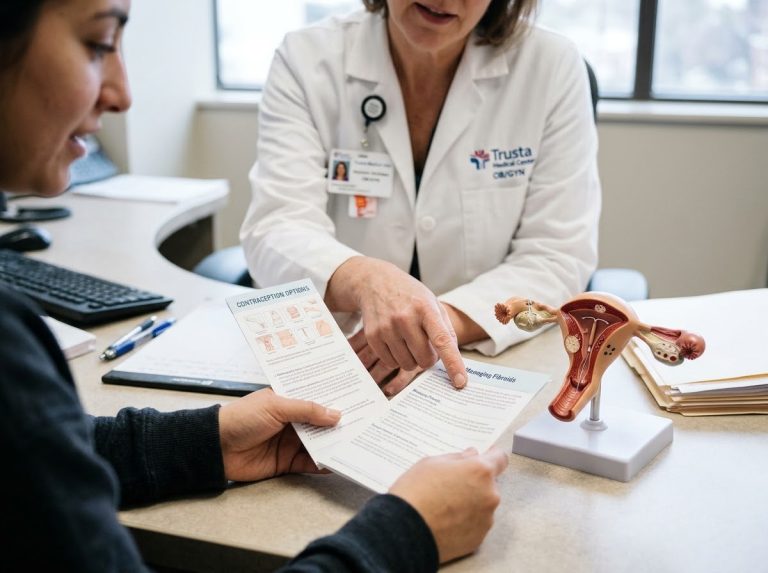

Some questions about inherited conditions are hard to say out loud. Could something that runs in the family reach a future baby? Is that test result as serious as it sounds? Genetic counseling in Dubai at Trusta Medical Center gives those questions somewhere calm to go.
Our doctor, Dr. Zohreh Kazemi, starts by going through medical history, family history, pregnancy details and any test results. After that she explains the risks in plain language, which tests exist and what each one can and can’t tell you. Decisions afterwards stay with you.
Genetic counseling is a conversation first. Testing is optional. Plenty of people leave with answers and no test at all.
What is genetic counseling?
Genetic counseling is a medical conversation about conditions that run in families and the chance of passing one to a child. The conversation itself needs no needle and no sample. MedlinePlus describes it as a way for parents to learn how likely a child is to have a genetic disorder, which tests can check for one and whether to have them at all.
Expect the conversation to cover:
- Who in the family had which condition, and at what age
- The chance of passing a condition to a child
- What a high-risk or unclear screening result really means
- Testing options: carrier screening, non-invasive prenatal testing and diagnostic tests
- How inherited conditions move from parents to children
- Questions that come up before or during pregnancy
Why is genetic counseling needed?
Test results and family stories rarely explain themselves. A condition that skipped a generation, a result flagged high risk or an earlier pregnancy that ended with a diagnosis can leave a pile of questions. A short appointment seldom has room for them.
Counseling gives them proper time. MedlinePlus notes that ACOG recommends offering carrier screening to all women, ideally before pregnancy.
Genetic counseling in Dubai and the UAE
Some recessive conditions are more common in this region. Thalassemia is the best known. In Dubai Health Authority premarital screening, 8.5% of 6,420 UAE nationals tested were suspected carriers of a blood disorder.
Marriage between relatives also raises the chance that both parents carry the same gene. A UAE University study of 2,200 women in Dubai and Al Ain found that 50.5% of marriages were between relatives. Counseling gives couples accurate numbers to plan with.
Already had premarital screening? Bring the report. Our doctor checks what it covered and whether anything else is worth testing. Carrier screening before pregnancy also sits inside our preconception health screening.
Benefits of genetic counseling
- You learn how likely a condition is, in numbers where possible
- Medical terms get translated without rushing
- You decide with the facts in front of you
- Tests that make sense get separated from tests that can wait
- Timing and options for future pregnancies become clearer
- A plan exists before conception instead of a surprise afterwards
When should you consider genetic counseling?
Several situations call for it.
Before conception, inherited risks are far easier to understand than once a pregnancy has started. Our preconception care page explains the wider check-up.
During pregnancy, counseling helps when prenatal tests or a pregnancy ultrasound point to a possible genetic condition.
A known genetic condition in the family is reason enough by itself. The same goes for an abnormal prenatal test result that needs explaining.
Some couples also look at the genetic side after trying for a long time without success. Our fertility tests cover the other half of that picture.
What genetic counseling includes
Our doctor reviews medical history, family history, earlier pregnancies and test results, then decides what, if anything, to add. A blood test that looks at chromosomes or specific genes may follow.
Results show the odds of passing a condition on, such as a 1 in 4 chance of an affected child in each pregnancy when both parents carry the same recessive condition (MedlinePlus).
Genetic testing counseling
Counseling doesn’t always lead to a test. When one is on the table, our doctor explains what it checks, what it can miss and what the possible results mean before anything is done.
Screening tests such as non-invasive prenatal testing estimate the chance of a chromosome condition by looking for baby DNA in the mother’s blood. Diagnostic tests such as amniocentesis and chorionic villus sampling look at the baby directly. MedlinePlus warns that tests differ in accuracy and that invasive ones can cause infection or miscarriage, which is why each one gets a proper discussion first.
How genetic counseling works
- Medical history. Our doctor goes through general health and pregnancy history.
- Family history. Relatives with genetic conditions, birth defects, miscarriages, stillbirths or severe childhood illness all matter, so a rough family tree helps.
- Risk evaluation. Our doctor weighs the information to spot possible genetic risks.
- Tests. If one is needed, our doctor describes what it checks and what to expect.
- Results and next steps. Our doctor explains the findings and lays out clear options.
Is genetic counseling safe?
The conversation itself involves no procedure. It is advice, with no needles or instruments. Any test that follows has its own risks. Our doctor explains those before it goes ahead.

Who needs genetic counseling?
Counseling is particularly worth considering with:
- A family member or child with a genetic condition or birth defect
- A previous pregnancy affected by a genetic condition
- Three or more miscarriages
- An abnormal prenatal screening result or ultrasound finding
- A known genetic mutation in the family
- Marriage between relatives
- Diabetes or another health condition that may affect the baby
- Southeast Asian or Mediterranean origin, where thalassemia is more common
- General worry about inherited conditions
MedlinePlus adds that ACOG now recommends genetic screening for women of every age, with no cut-off at 35.
Genetic counseling during pregnancy
During pregnancy, counseling helps explain screening results and whether further testing is needed. Our doctor weighs gestational age, family history, examination findings and test results together.
Routine antenatal care carries on alongside. If a result calls for closer follow-up, high-risk pregnancy care adds more checks.
Why choose our doctor for genetic counseling?
- Time to listen first. Dr. Zohreh Kazemi learns the medical and family history before discussing any risk.
- Plain language. Results and options come without jargon.
- Honest testing advice, including limits and risks.
- One obstetrician and gynecologist from the first conversation through pregnancy care.
- Decisions that stay with you.
Book genetic counseling in Dubai
Questions about inherited conditions, pregnancy screening or family genetic risk? Book a consultation or call +971 54 555 0770. Bring notes on family health history (even a rough family tree), any screening reports and the questions that keep coming up.
We’re open every day, 9:30 am to 10:00 pm at Trusta Medical Center in Downtown Dubai.
FAQs
Is genetic counseling only for pregnant women?
Couples can have counseling and tests before pregnancy too, as MedlinePlus explains. It also helps anyone with a family history of an inherited condition.
Does genetic counseling mean I have to have a test?
Testing is optional. Our doctor explains each option. The decision is yours.
What is the difference between screening and diagnostic tests?
Screening estimates how likely a condition is. Diagnostic tests look for the condition itself and carry more risk, so they’re offered after a good discussion.
Can both partners be carriers without knowing?
Carrier screening checks for gene variants that people may not know they have, MedlinePlus notes. Carriers are often completely well, so both partners can carry the same condition without knowing.
When do I need genetic advice?
You may need it prior to conception, during pregnancy, following abnormal screening results or due to a family history of an inherited disease.