
You’ve been trying for a few months. Maybe longer. And now you’re wondering if something’s off.Knowing how to test female fertility replaces that guessing with real answers. The process is shorter than most women expect: a conversation about your history, some blood work, an ultrasound and sometimes a dye scan of your tubes.Most of it fits inside one or two menstrual cycles.
When to get a fertility test
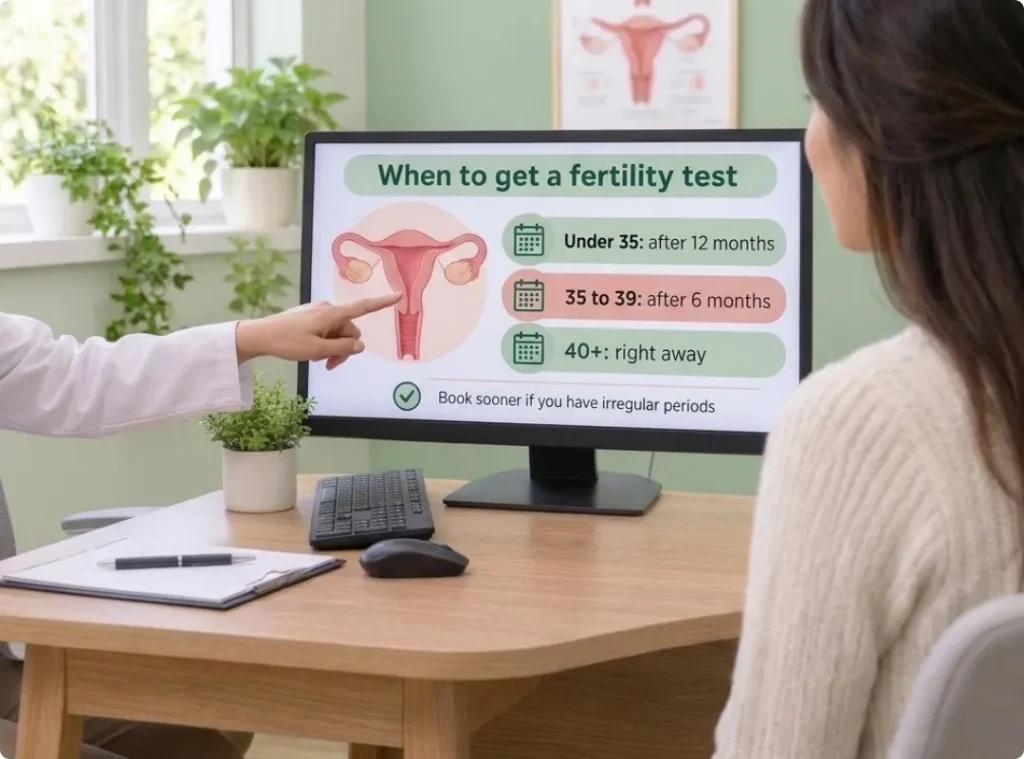
Doctors set the starting line by age. The clock runs from the day you started trying without contraception.
Timelines by age
- Under 35: after 12 months of trying
- 35 to 39: after 6 months
- 40 and over: right away
Those numbers apply when nothing else is going on. If you have any of the signs below, book sooner.
Signs of female infertility worth checking early
- Periods that are irregular or missing for months
- Very painful periods or pain during sex, which can point to endometriosis
- A past pelvic infection or pelvic surgery
- A past ectopic pregnancy or 2 or more miscarriages
- PCOS, thyroid disease or fibroids
- Chemotherapy or pelvic radiation in your history
Plenty of women with fertility problems have no symptoms at all. Regular periods suggest you ovulate. They tell you nothing about your tubes or your uterine lining.Not trying yet? A preconception care visit lets you test early, start folic acid and review your medications before you begin.
How to test female fertility: 6 steps
A full workup follows a logical order. Each step rules something in or out, so the next one makes sense.
Step 1: medical history and physical exam
Your doctor starts with questions. How long you’ve been trying, your cycle length, past pregnancies, surgeries, infections, medications and lifestyle. She’ll ask about your partner’s health too.
Expect a general exam and often a pelvic exam. A Pap test gets added if you’re due for one. Bring the start dates of your last 3 to 6 periods. They tell the doctor more than most single blood tests.
Step 2: check whether you ovulate
No ovulation means no pregnancy, so this check comes first. You can do it 3 ways.
Cycle tracking and ovulation kits
Track the first day of every period. Add urine ovulation kits, which detect the LH surge that comes right before ovulation.A steady cycle of roughly 25 to 35 days usually means you ovulate. Cycles that swing wildly deserve a closer look.
Progesterone blood test
Progesterone rises after ovulation. A blood test about 7 days after you ovulate confirms it happened.In a 28-day cycle that lands around day 21. Longer cycles shift the date later.
Follicular study
A follicular study tracks your follicles with transvaginal ultrasound. Scans usually start around day 8 to 10 of your cycle and repeat every 1 to 2 days.A follicle typically grows to about 18 to 24 mm before it releases an egg. The doctor also measures your uterine lining. It’s the closest thing to watching ovulation happen live.
Step 3: hormone tests for fertility
Blood work gives the doctor a hormone snapshot. The usual panel looks like this:
- AMH: estimates your remaining egg supply. You can draw it on any day of your cycle.
- FSH and estradiol: drawn on day 2 to 5 of your cycle. A high FSH can point to lower ovarian reserve.
- TSH: checks your thyroid, which can throw off ovulation.
- Prolactin: high levels can stop ovulation. Doctors prefer a morning blood draw because stress and time of day can shift the number.
- Testosterone and other androgens: added when PCOS is suspected.
The National Institute of Child Health and Human Development lists FSH and AMH among the standard blood tests for judging a woman’s remaining egg supply.AMH reflects egg quantity. Egg quality depends mostly on your age.
Step 4: pelvic ultrasound and antral follicle count
A pelvic ultrasound does a lot of the heavy lifting in any female fertility test. Doctors usually perform it transvaginally because it shows more detail.It reveals the shape of your uterus. It also picks up fibroids, polyps, ovarian cysts and the typical look of polycystic ovaries.
On day 2 to 5 of your cycle the sonographer also does an antral follicle count. These are the tiny resting follicles in each ovary. A low count suggests a smaller egg supply, and doctors read it next to your AMH result. Together they make up an ovarian reserve test.
Step 5: check your tubes and your uterus
Eggs travel through the fallopian tubes. Blocked tubes are a common cause of trouble, and no hormone test can see them.
HSG (hysterosalpingography)
An HSG is an X-ray scan with contrast dye. The doctor passes the dye through your cervix and watches whether it flows through both tubes. It also outlines the inside of your uterus.The scan happens after your bleeding stops and before ovulation. That timing makes sure you’re not pregnant.
The imaging itself takes a few minutes. Expect cramping similar to a strong period pain. Ask your doctor about taking an over-the-counter pain reliever about an hour before. Some doctors also prescribe antibiotics if you have a history of pelvic infection or a known tubal problem.
Other options
Saline sonohysterography and HyCoSy use ultrasound and fluid instead of X-rays. Hysteroscopy puts a thin camera inside your uterus. Laparoscopy looks at the outside of the uterus and tubes and can spot endometriosis.
The last two are only for cases where earlier tests point to a problem.
Step 6: test your partner and screen for other causes
Fertility is a team result. A semen analysis is quick and painless. It can run alongside Steps 2 to 4, so you don’t lose a cycle waiting.Your doctor may also screen for infections such as chlamydia, which can scar the tubes without any symptoms. If infertility or genetic conditions run in your family, genetic counseling belongs on the list too.
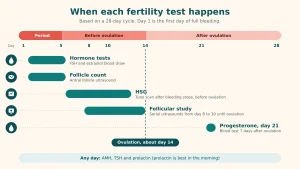
Female fertility tests at a glance
Test | What it checks | Best timing |
Cycle tracking and LH kits | Whether you ovulate | Every cycle |
Progesterone blood test | Confirms ovulation | About 7 days after ovulation |
Follicular study | Follicle growth and lining | Serial scans from day 8 to 10 |
AMH test | Egg supply | Any day |
FSH and estradiol | Ovarian reserve and hormone balance | Day 2 to 5 |
TSH and prolactin | Thyroid and ovulation blockers | Any day (prolactin: morning) |
Antral follicle count | Resting follicles in the ovaries | Day 2 to 5 |
HSG | Fallopian tubes and uterine cavity | After bleeding stops and before ovulation |
Semen analysis (partner) | Sperm count and movement | After 2 to 7 days without ejaculation |
Day 1 is the first day of full bleeding.
Can you test female fertility at home?
Partly. Most at-home fertility tests for women cover only the first rungs of the ladder.Ovulation kits show your LH surge. Finger-prick kits measure hormones such as FSH and sometimes AMH.
They have limits. No home kit can see your tubes or your uterus. None can diagnose PCOS or fibroids. A single hormone reading can also mislead you when your cycle varies.Use a home result as a reason to book a visit.
What your results can and can’t tell you
Normal results don’t guarantee pregnancy
About 3 in 10 couples with infertility get normal results across the board. Doctors call this unexplained infertility.It’s frustrating to hear. It also means the basics are fine, and treatments such as IUI or IVF still have good odds in many of these cases.
A low AMH isn’t a verdict
Women with low AMH conceive naturally every day. Reproductive medicine guidelines say ovarian reserve tests can’t predict whether you’ll fail to conceive. They shouldn’t be used to deny treatment either.What a low number does say is that time matters more for you.
What happens next
Your plan depends on what the tests find. It might be ovulation medication, treatment for PCOS or thyroid disease, removal of a polyp or fibroid, or fertility treatment.At the clinic, fertility tests come with a plan for the next step no matter what the results show.
How to prepare for your fertility testing appointment
A little prep saves you a second visit.
- Track your cycle for 2 to 3 months before you go
- Bring old scans and lab reports
- Write down every medication and supplement you take
- Ask for a visit around day 2 to 5 of your cycle if you can, so the blood tests and the follicle count happen together
- Start 400 micrograms of folic acid daily if you haven’t already
- Bring your partner or book a semen analysis for the same week
Mistakes that slow things down
- Relying on AMH alone
- Waiting 2 years because the results “might be fine”
- Skipping the partner’s semen analysis
- Testing on the wrong cycle day
- Judging your fertility from one hormone reading
Fertility testing in Dubai with Dr. Zohreh Kazemi
Dr. Zohreh Kazemi sees patients at Trusta Medical Center in Downtown Dubai. She has more than 18 years of clinical experience as an obstetrician and gynecologist.
She reviews your history first and orders only the tests that fit your situation. Then she explains every result in plain language.Irregular cycles, suspected PCOS and fertility questions all fall under her general gynecology care.
Conclusion
Knowing how to test female fertility comes down to 6 steps: history and exam, ovulation checks, hormone tests, ultrasound, a tubal scan and a partner workup.Book sooner if you’re 35 or older or have any warning signs. Track your cycle in the meantime and start folic acid.Ready for answers? Book a visit with Dr. Zohreh Kazemi at Trusta Medical Center in Downtown Dubai and start your fertility testing with a clear plan.
Frequently asked questions
How long do fertility test results take?
Ultrasound findings are available during your visit. Blood results often come back within a few days. An HSG is usually read on the same day.
Can I get tested if my periods are regular?
Yes. Regular periods suggest ovulation but say nothing about blocked tubes or uterine problems. Many women with a normal cycle still need a full workup.
Do both partners need testing?
Yes. A male factor is involved in a large share of cases. Testing both of you from the start usually saves months.
Can lifestyle changes improve my results?
Sometimes. Weight, smoking, alcohol and sleep all affect ovulation. For women with PCOS or a high BMI a modest weight change can restore regular cycles. Lifestyle can’t reverse age-related changes in egg supply.
How much does fertility testing cost?
The price depends on which tests you need. The clinic can give you a quote after your consultation. Ask which tests are essential and which are optional.
Should I start with a gynecologist or a fertility specialist?
A gynecologist can run all the first-line tests and refer you onward only if you need advanced treatment. Starting there keeps things simpler and often cheaper.